A handgun can save your life or someone else’s, and it can just as easily injure you or a bystander. Students are a good example of why people take up shooting: campuses have been targets for attacks, and individual students get assaulted. The same logic applies to anyone who wants a firearm as part of a home-defense or prepping plan. When the moment comes, you will most likely shoot back, and a shot that misses can cost you your life or the life of somebody standing behind the target. The only reliable answer is training before you need it.
This guide walks through the fundamentals in the order a new shooter should learn them: safety rules, grip, recoil, trigger control, stance, reloading, holstering, and range manners. None of it replaces a qualified instructor, but it will tell you what a good instructor is going to teach, and it will give you something to check your own habits against.
Start with the safety rules #
Safety comes before everything else. A gun is a tool with the power to protect you, and the same power makes it dangerous to anyone near it. People have died in accidents with their own firearms, which is why the basic rules are worth repeating until they are automatic.
The rules come down to four habits. Treat every gun as though it could fire. Keep your finger off the trigger and alongside the frame until you have decided to shoot. Point the muzzle only at something you are willing to destroy. And know your target and what lies behind it. A bullet that misses, or passes through, keeps traveling, so if you have no idea what is beyond the target, you don’t shoot.
Keep the handgun holstered, with the safety on if it has one, whenever you aren’t ready to fire. Draw it only when you are ready to engage targets downrange. That matters most at a range with live ammunition, where extra care is expected of everyone on the line.
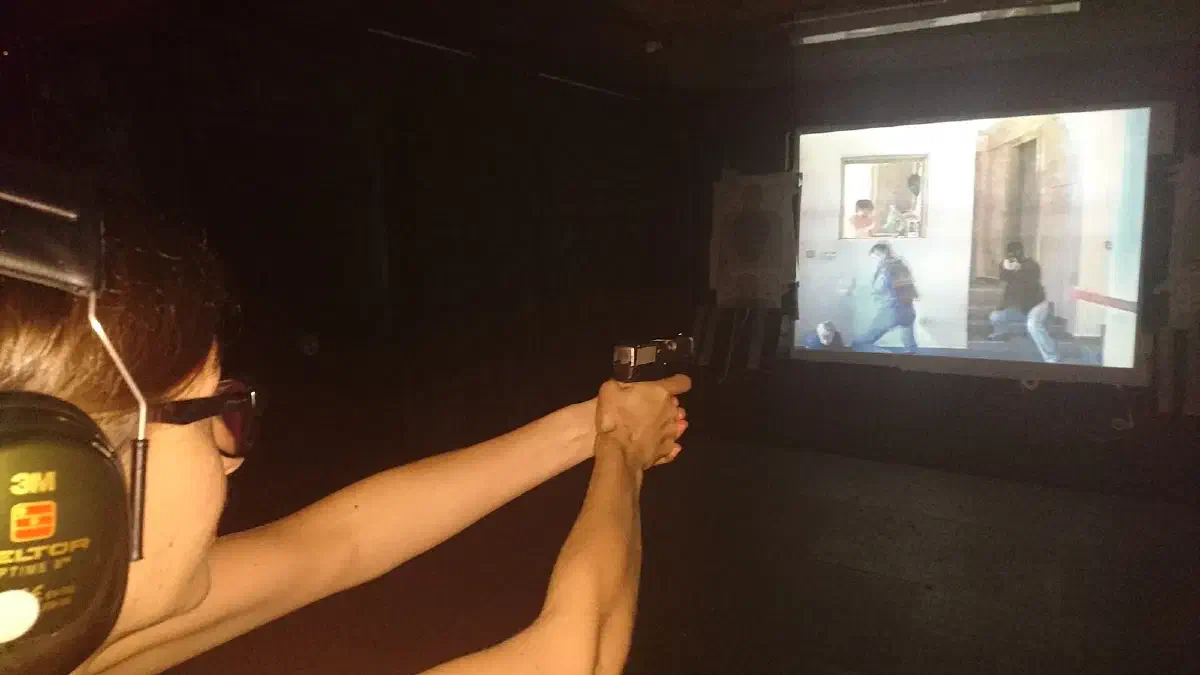
If you move on to close-quarters drills in a kill house, use dummy rounds. When you clear the building with friends, or with human role players acting as targets, take every live round out of the house first and confirm that the only ammunition anyone carries is dummy ammunition.
Get a grip #
Grip decides whether the gun stays steady or sways in every direction. A weapon that jumps around in your hands is dangerous to you and to the people near you, and it makes accurate shooting close to impossible.
Beginners should shoot with both hands. Take the gun in your dominant hand first, with the trigger finger laid straight along the frame and not on the trigger or firing pin. Then bring the other hand in to cover the open space on the opposite side. Keep that support hand out from under the magazine well, where it serves no purpose and can throw you off. In a good grip, both thumbs sit side by side along one side of the pistol. Once the hands are placed correctly, tighten your hold. A firm grip gives you much more control while firing, and it reduces the chance of a malfunction caused by shifting hands.
Dont brace for the recoil #
Recoil depends largely on caliber. The .22, the .38 and the 9mm are the common choices among qualified civilian shooters. Many beginners assume a smaller gun means gentler recoil, and it often doesn’t. Small, light pistols can kick hard, so a beginner is better served by a medium or full-size pistol that fits the hand.
The second beginner mistake is anticipating the recoil. People expect the muzzle to go up, down, or sideways and flinch in advance, which pulls the shot off line. In a real encounter that is how rounds end up where they shouldn’t. Let the recoil come as it comes. Relax, breathe, and keep everything still except the trigger finger while you squeeze.
Size matters for another reason. A larger frame is easier on the hands, but comfort shouldn’t be the only factor. Choose a gun that suits your body and the size of your hands. If you prefer the comfort of a larger gun you can pick the 9mm. The .38 and .22 are smaller options, and you shouldn’t write off a small gun, because it can have a lively recoil of its own.
Trigger control #
The shot is decided by one squeeze of the trigger, so this is the most important skill in the course. Once your grip is firm and the target is on your sights, squeeze gently. Don’t yank.
Place the pad of the finger, the middle of the first segment before the first joint, on the trigger. If you use the tip of the finger, or the crease of the joint, you push the gun to one side and the recoil is magnified in that direction. Used correctly, the finger moves straight back and the gun doesn’t sway from left to right.
Between shots, take the finger off the trigger and lay it along the frame beside the barrel. Keeping it on the trigger at all times is how accidental discharges happen. Hunters rehearse this constantly before the season opens, and with enough repetition it becomes second nature.
Stance #
How you stand governs how true your shots are. There isn’t one stance, and you should learn to shoot standing, kneeling, and prone. What they share is that you extend your arms fully when you’re ready to fire, which lets you see the target clearly through the sights. In rare cases you may have to shoot with the pistol held closer, but extended arms are the standard.
For the standing position there are three common stances. The isosceles stance gives comfort through a natural, squared-up body position. The fighting stance is good for firing effectively from any weapon. Both are generally used by experienced shooters. The Weaver stance controls recoil well, which is why beginners are usually taught it. To get into it, blade your body, point the foot toward the target and shift your support side in the firing direction.
Whichever you pick, put your dominant foot slightly ahead of the other, relax your shoulders, breathe, and then fire. Even when kneeling, don’t let your shoulders ride up to your ears.
Reloading #
On a range, someone may hand the gun back to you loaded. Outside the range, nobody will reload for you. Learn how the magazine mechanism works: how to release the magazine from the pistol and how to seat a fresh one. A detachable magazine feeds cartridges up into position by the chamber as the action cycles, and you load it by hand or with a clip.
Practice loading rounds into a magazine quickly and cleanly, and then inserting it. Speed matters because every second you spend fumbling gives an attacker an opening. Practice reloading after you have fired the entire magazine, and breathe in and out to settle your nerves first. When you panic, rounds and magazines get misaligned, and fixing that takes more time than doing it calmly would have. Make sure you’re safe before reloading in a life-threatening situation, take a deep breath, and then go back on target.
Holstering and carry #
A holster keeps the gun in a known place, stops it from moving around, and keeps it out of an enemy’s reach while still letting you get to it. A good holster, whether on a belt, a waistband, or at the ankle, lets you use your dominant hand quickly if you need the gun.
An ordinary belt holster carries the gun outside your clothes. Plenty of people prefer to conceal it. The most popular concealed method is the inside-waistband (IWB) holster on the dominant-hand side, with variants worn at the back. Appendix inside-waistband carry (AIWB) is one of the best for protecting the gun against someone trying to disarm you, and the pistol is quick to withdraw. It also needs extra care, because if the safety is off, nasty mistakes can happen. Shoulder holsters are an option as well. Find the style that suits you and stick to it. Whatever you choose, it should let you draw quickly and re-holster easily.
Traveling with a handgun and knowing the law #
Firearm laws differ from place to place, and you need to know the rules wherever you are. Before a trip for hunting or any other purpose, look up the laws that apply at your destination so you stay out of trouble. Even hunting grounds have reasonable regulations, such as not shooting within 200 yards of a building and no alcohol on site.
Take active precautions whenever you handle a handgun. The slightest mistake can harm someone nearby, so follow every rule to the letter.
Range etiquette #
A range has its own code of conduct, and you should learn it before you take responsibility for a loaded gun. Get to know the vocabulary: firing line, downrange, hot and cold, backstop, lanes. Stay aware of your surroundings, know your intention before you fire, and handle the gun the way the range officer expects.
There is a dress code too. Wear closed shoes, avoid V-neck shirts, and keep long hair tidy so it doesn’t distract you.
Hire an instructor #
Have an instructor, or an experienced friend or family member, with you whenever you handle a gun. It’s far better to pay for lessons than to pay for a lawsuit after you shoot at the wrong target. Training is also more fun when you know what you’re doing, and a good instructor will show you the tactical methods that make you want to keep learning. If you secretly want to shoot like the movies, an experienced handler is the person who will get you to real skill.
Bottom line #
Don’t dismiss firearms for self-defense, but treat them as what they are: a self-defense tool, not a toy. Make that your guiding principle before you hire an instructor to take you through the process. Follow the rules above, practice until the habits are automatic, and you will be safer and so will everyone around you.
Related reading: Security and communications; The Best Firearm For Home Defense: A Comprehensive Analysis; Top 9 Prepper Handguns