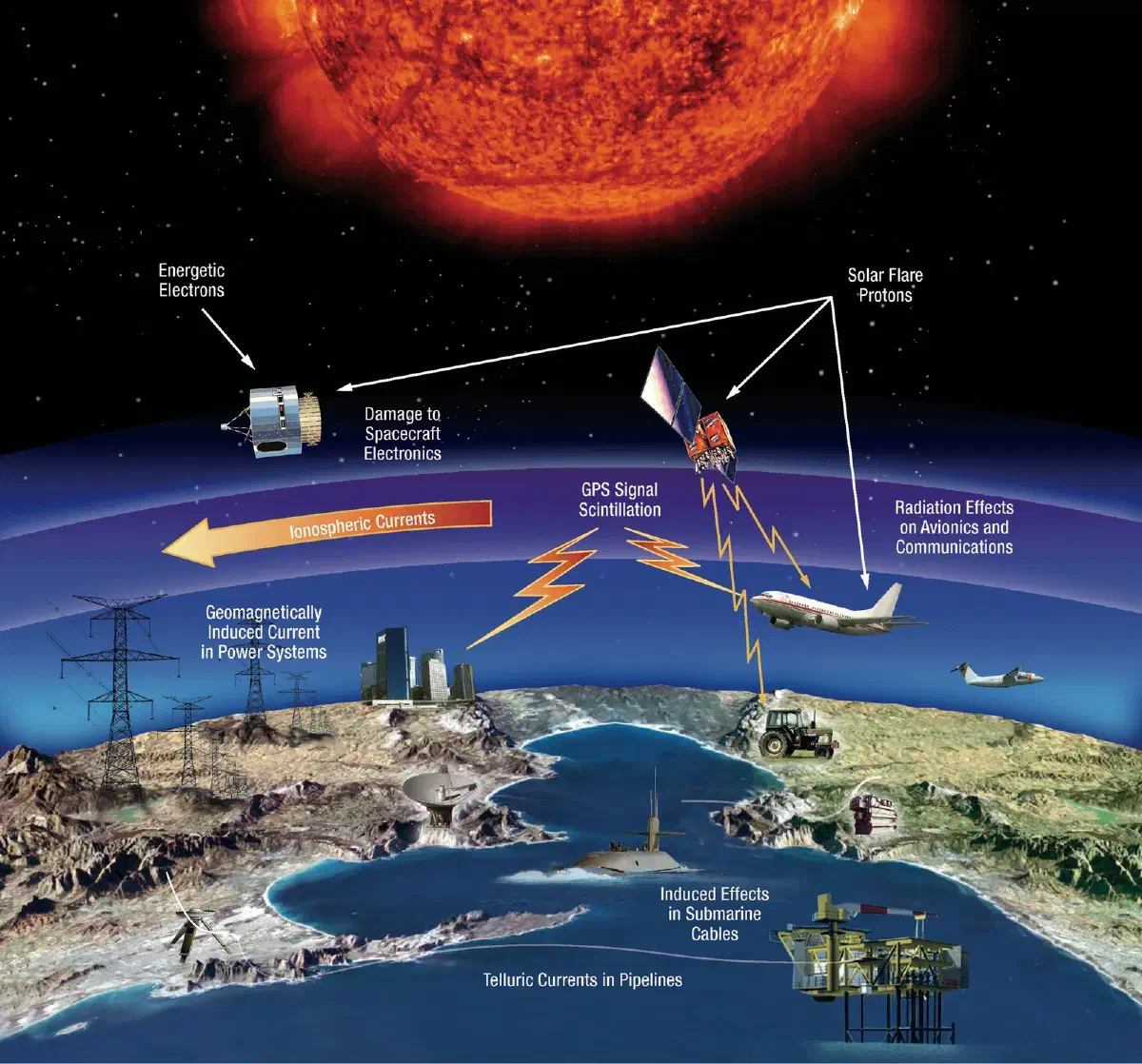
Most preppers build their plans around events they can see coming: a hurricane track, a flood forecast, a hard winter. Space weather is different. It starts 150 million kilometers away, it can arrive with a day or two of warning at best, and the damage lands on the one system the rest of your plan quietly depends on, the electrical grid. A strong solar storm is a low-frequency event, but it belongs on the list beside the other grid-down scenarios, and the preparations overlap heavily with the ones you probably already have.
Most of the practical work is hardware protection, covered in how to keep your electronics safe from EMPs and build a Faraday cage. For what to do when the grid is gone for good, see the EMP survival plan and the wider crisis and medical hub.
What space weather actually is #
Space weather is the set of conditions in space that the sun drives: solar wind, radiation, magnetic fields and plasma. Most of the time it is background noise. The trouble comes from two kinds of eruption.
A solar flare is a sudden burst of energy from the sun’s surface. It releases X-rays and ultraviolet light, which reach Earth in minutes and can disturb radio communications on the sunlit side of the planet.
A coronal mass ejection (CME) is a cloud of charged particles and magnetic field thrown off the sun. It travels more slowly, typically taking a day or more to arrive, and when it hits Earth’s magnetic field it can set off a geomagnetic storm. That second event is the one that threatens infrastructure.
The two often come together, which is why articles on this subject tend to blur them. For planning purposes, think of flares as a communications problem and CMEs as a power-grid problem.
What a severe storm can do #
The effects are well documented, and they fall into a few categories.
- Power grids. A geomagnetic storm induces currents in long conductors such as high-voltage transmission lines. Those currents can overload transformers and trip protective equipment, leading to widespread blackouts and, in the worst case, damaged transformers that take a long time to replace. In March 1989 a geomagnetic storm collapsed the Hydro-Québec grid in about 90 seconds and left millions of people without power for roughly nine hours.
- Satellites, GPS and weather forecasting. Storms disrupt satellite communications and degrade GPS signals, which affects navigation, aviation, timing systems and the data feeds that weather forecasts rely on.
- Radio. High-frequency radio, the band used by aviation, maritime and many emergency services, can black out during a storm. Amateur operators notice first.
- Radiation exposure. Astronauts and airline crews flying at high altitude take a higher dose during major events, with potential long-term health effects.
The benchmark for a truly severe storm is the 1859 Carrington Event, when telegraph systems failed across Europe and North America and some operators reported sparks and shocks from their equipment. Telegraph wires were the grid of their day. A comparable storm today would meet a far more electrified, interconnected world.
Flares, storms and EMPs are not the same thing #
Some preppers lump solar storms in with electromagnetic pulses, and the confusion leads to wasted money. A nuclear high-altitude EMP delivers a fast, intense pulse that can damage electronics directly. A solar storm is slow by comparison and mostly hurts through long conductors, meaning the grid, pipelines and long cable runs. Your phone sitting on a table is at far less risk from a CME than your local substation is.
That said, the two share countermeasures. Surge protection, spare electronics in shielded storage and a plan for living without grid power cover both. If you want to go deeper on the pulse side, a dedicated guide to surviving an EMP scenario covers shielding and hardening in detail.
Step 1: Watch the sun #
You cannot prevent a storm, but you can usually learn about one. The Space Weather Prediction Center (SWPC), run by NOAA, publishes forecasts, watches, warnings and alerts for geomagnetic storms, solar radiation storms and radio blackouts. NASA also provides real-time solar observations. Sign up for SWPC email alerts, or check the site when news of a big eruption breaks.
Learn the scale as well. NOAA rates geomagnetic storms from G1 (minor) to G5 (extreme). A G1 or G2 is an aurora story. A G4 or G5 is the point where you check your supplies and top off the fuel.
When a CME is observed leaving the sun, you generally have a day or more before it arrives. That window is enough to charge batteries, fill water containers and run your vehicle’s tank up to full, and it is exactly why monitoring is worth ten minutes a week of your attention.
Build a stock that works without the grid #
The core of preparation for a long outage is the same as for any other long outage. Plan for at least two weeks of food, water and essential supplies per person, and more if you can manage it, because a damaged-transformer scenario could stretch past that. The supplies that matter most:
- Water: stored, plus a way to filter or purify more. Municipal pumps stop when the power does.
- Shelf-stable food that needs little or no cooking.
- Medications and a stocked first aid kit, including a backup pair of glasses if you wear them.
- Flashlights, headlamps and spare batteries.
- Hygiene supplies and a plan for sanitation if water pressure fails.
An emergency kit built for a winter storm covers most of this. What a space-weather event adds is the likelihood that the outage is regional rather than local, so help may be slower to arrive from neighboring areas.
Power you can actually rely on #
Backup power is where good intentions often fall apart. Solar panels, a generator, portable power banks: each has a place, but each needs maintenance.
Test your backup sources regularly, not once at purchase. Run the generator under load every few months and rotate its fuel. Keep power banks charged and cycle them. If you rely on solar, make sure you understand how your system behaves when the grid goes down, because many grid-tied systems shut off automatically for safety and give you nothing without a battery and the right inverter.
Keep a small set of spare critical electronics stored unplugged and out of use: a radio, a charge controller, a flashlight. If the system around you fails, you want something that has not been exposed to the event.
Communications when the usual channels fail #
Space weather hits communications twice, through satellites and through radio propagation. Cell networks may keep working locally until their backup power runs out, but you should not count on them for long.
Set up a family or group communication plan before you need it. That means a designated meeting point, a list of phone numbers on paper, and at least one non-cellular option: two-way radios for short range, a hand-crank emergency radio for receiving broadcasts, a satellite phone if the budget allows. Remember that satellite phones depend on the same satellites a storm may disrupt, so they are a supplement and not a replacement. Test your radios on a schedule, as you would your generator.
Protect the electronics that matter #
Faraday cages and shielded containers can protect devices during an event that includes a pulse. For a solar storm alone the risk to small devices is lower, but the cost of protecting a handful of essentials is small and the same storage works for other scenarios. Build or buy a shielded container and keep a backup phone, a radio, a small solar charger and your key data in it.
Add surge protectors at the household level. They divert excess electrical energy away from your equipment and are cheap insurance against the voltage fluctuations that accompany grid disturbances. Back up important files to an external drive stored away from your main devices, and keep paper copies of documents you could not do without.
Plan for the long haul #
Most space-weather advice assumes an outage of hours or days. Long-duration events are the ones that break plans, so build in a few measures that reward patience:
- Write the plan down. Describe what you will do on an alert, who is responsible for what, and which supplies to check first. A plan in your head collapses under stress.
- Run drills. Pick a weekend and turn off the main breaker. Cook, wash and communicate without grid power for 24 hours. Gaps show up quickly: the can opener nobody can find, the dead battery in the radio.
- Add redundancy. For every critical function (light, heat, water, communication) have at least two ways to do it, and at least one that needs no power at all.
- Reduce fragility. Surge protection, shielded spares and manual alternatives such as paper maps, hand tools and a mechanical clock make your household less dependent on the systems a storm might disable.
If you run a small business or a home office, the same logic applies at a larger scale: a written response plan, assigned roles, regular drills, and backups for the systems you cannot be without.
Know your exits #
Most space-weather events will not require you to leave home. A prolonged grid failure in a cold climate, or a loss of water in a hot one, could. Identify evacuation routes in advance, pick two destinations in different directions, and keep your vehicle fueled during any storm watch. Know where the nearest shelters and community centers are, and set a meeting point for the family in case you are separated when communications fail.
A reasonable level of concern #
Space weather is neither something to ignore nor something to lose sleep over. Severe storms are infrequent, the effects are mostly on infrastructure, and the preparations are ones you would want anyway for any extended outage. If you are building a plan from the beginning, start with the basics: two weeks of supplies, working backup power, a non-cellular communications plan, and a habit of checking the SWPC when the news turns toward the sun. Then add the extras, such as shielded storage and written drills, as your budget and time allow.