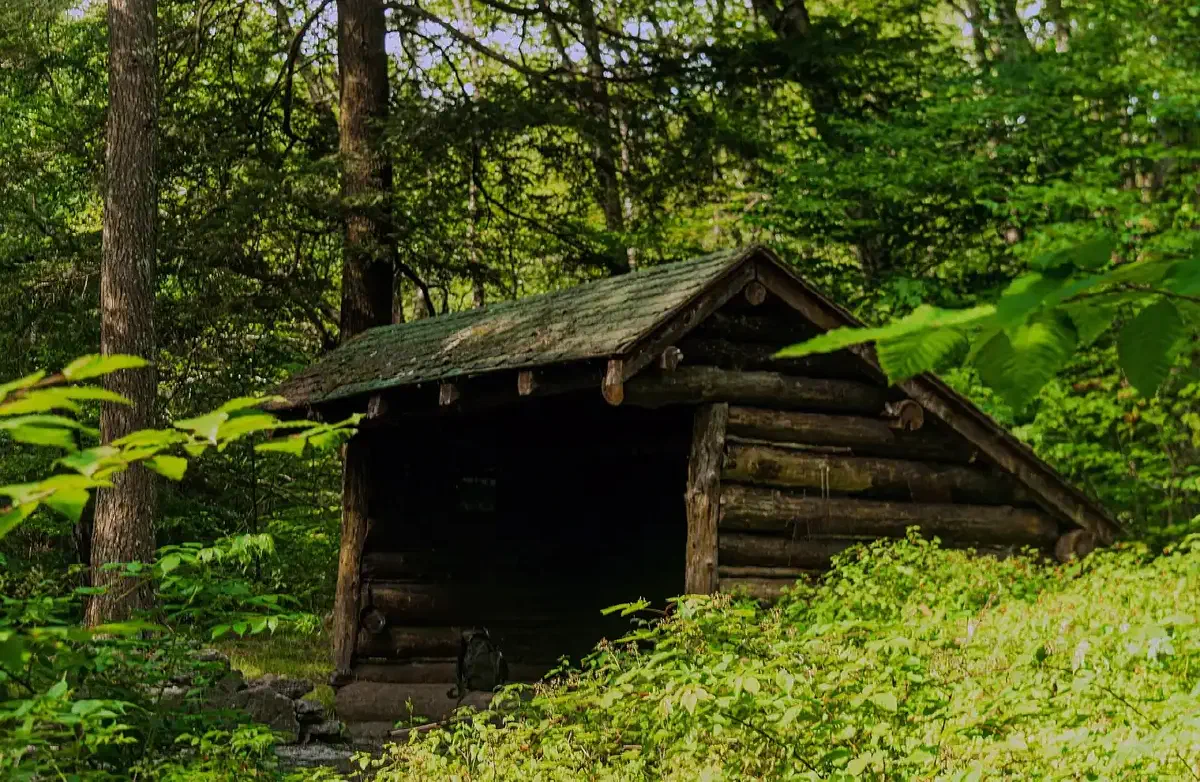
Plenty of people who get into trouble outdoors do not run out of food or water first. They lose body heat. Cold wind, rain and snow pull warmth out of you faster than most people expect, and once you are cold and wet, every other decision gets harder. A shelter and a fire, in that order of priority for most situations, are what hold your body temperature up.
This guide covers how to choose a site, how to decide what you need, and how to build the main types of shelter, from quick tree-based ground shelters to the permanent camp shelters used at a regular campsite.
Three decisions before you build #
Whether you are stuck in the woods for a few days or planning a long-term shelter at a camp you visit often, the same three questions come first: where, what do you need, and what type.
Choose the site #
A good shelter site is dry and flat. Flat ground is better for sleeping, and it also keeps rainwater from running into the shelter. Beyond that, the site should be:
- Near water, but not next to it. Close enough to reach a source, but far enough that rising water cannot flood you. Water levels can change fast, and a shelter next to a stream can flood in seconds.
- Clear of hazards. Do not build under cliffs, falling rocks or dead limbs. Falling trees and branches are a leading cause of forest accidents.
- Out of runoff paths. Do not build at the base of a steep slope, or on ground lower than the surrounding area. If you have no choice, dig trenches around the shelter to divert water.
- Out of the worst wind. Avoid mountaintops and open ridges, which are exposed to strong winds, and avoid narrow valleys, ravines and washes, where cold air and water collect.
- Suitable for a fire. You want a spot where you can safely build one.
- Matched to your goal. Depending on whether you want to be found or stay hidden, the shelter can be visible or well camouflaged.
Avoid muddy and swampy ground and bumpy, uneven sites. Choose the least bad option you can find.
Work out what you need #
Ask yourself some questions. How many people will use the shelter? What are the weather and climate? How long will it serve you, since “permanent” can mean different things? Will you have a fire inside or in front of the shelter? How much time do you have, and what tools do you have to work with?
A shovel, knife, axe or machete makes life far easier. If you will build a long-term shelter, bring some of these items in with you: good cordage such as paracord, a lighter, a tarp, a shovel, a multi-tool, a hatchet, a survival knife, heavy-duty gloves and a bivy sack. Keep the weight down, and test every tool before the trip. A tool that fails at a critical moment costs you much more than the time it took to check it.
Choose the type #
There are many designs: tarp shelter, tent, fallen tree, A-frame, lean-to, wickiup, snow cave and more. Learn several, so you can pick the one that suits your site, materials and time. If a shelter takes a long time and a lot of effort, it is often better, but not if you do not have the daylight to finish it.
Why build near trees #
A shelter near trees is the most common choice, because trees provide a lot of what you need. They supply fuel for fire and tools to start it. They give concealment and cover from the weather and from animals. Many species produce edible fruits and nuts, some collect rainwater, and a few provide drinkable water. And the trees themselves give you a strong frame to build on.
Ground-based tree shelters #
Fallen tree #
Trees with shallow topsoil tend to blow over, leaving a root ball and a trunk lying on the ground. A root ball can be bent or broken and used as a wall or a partial roof. Using the fallen trunk as a ridge, you can build walls and a roof as large as you need. Not every fallen tree will work, so keep an open mind and check the site first.
Tree wells #
The hollows that form around trees in snow are called tree wells, and they are unreliable. Their shape depends on the tree, the terrain, the wind and the weather. If you look at one, you want drier ground and materials, shallower snow, some kind of overhead protection and a barrier against the wind. Many will not meet that standard.
Buttress trees #
Trees with buttresses grow in coastal areas and rainforests. The space between two buttresses can serve as walls, with leafy branches for a roof. You will usually need a windbreak on two sides.
Hollow trees #
Some trees have large hollows among the roots or in the trunk. A strong hollow tree can be a ready-made shelter that needs no building. Inspect it carefully before you settle in, and check for occupants such as animals and insects.
Shelters you can build at camp #
Lean-to #
The lean-to is the simplest and roomiest design. Find two tall trees about 8 feet apart, and tie a sturdy branch across them to form a crossbar. Lean additional branches along it about a foot apart, tying each with cordage. Fill the gaps with smaller branches, bushes and debris, or cover the frame with a tarp. Face the open side away from the prevailing wind, and put a fire in front.
Wickiup #
The wickiup uses lots of branches and limbs to make a funnel-shaped frame. Gather dozens of straight branches, tie them with paracord, and set the funnel in the ground with the narrow end up. Cover it with leaves, brush and other vegetation until it is warm inside and watertight. The shape sheds water, and the thick covering gives shade in hot weather. Slide in with a sleeping bag, and you have a comfortable shelter.
Snow cave #
In deep snow, a snow cave shelters you from cold air and wind. Choose a deep bank of snow on the side sheltered from wind. Dig a tunnel into its side with a shovel, then dig upward and inward to create a sleeping platform, which should be higher than the entrance so that the cold air sinks out. Keep the roof thick, and punch a few holes in the walls for ventilation. Avoid sweating while you dig, since damp clothing will chill you when you stop.
Tree pit shelter in snow #
A tree pit uses a large evergreen tree to give you a head start. Pick a tall, healthy tree with bushy branches, one that is not split and does not have large dying limbs. Cut some low-hanging branches first, because you will use them for the roof, the floor and the fire. Dig around the trunk down to the ground and widen the pit enough to sleep in and, if you want, to light a fire.
Line the floor with evergreen boughs so you are not lying on the cold ground, and pile more boughs over the top to make a roof. A tarp over them makes it more effective. Leave a good portion of the top uncovered for ventilation. A fire can be safe in a pit like this if you vent it, but carbon monoxide is a real danger without good ventilation. The snow around you provides most of the insulation.
Off-the-ground shelters #
Staying on the ground is usually better, but there are cases where getting off is smarter:
- Predators: getting up a tree can keep you away from dangerous animals.
- Snakes and venomous arthropods: off the ground, you are out of reach of most of them.
- Deep snow, rocky or steep ground: an elevated shelter can be safer.
- Spiny or irritating plants: getting up avoids them.
The most common off-ground shelter is a hammock. If you cannot bring one, gear that serves several purposes can replace it. A cargo net can work as a hammock and also secures bulky material or creates shade. Tubular webbing attaches carabiners and lines to a tree and can serve as a strap. Autolocking carabiners, mini carabiners and cordage hang a hammock and help with heavy lifting or lowering yourself from a tree. A military poncho or similar piece of gear adds modularity and flexibility.
Keep your head #
When you are in an emergency, stay calm. Panicking makes you forget the skills you have. If something is not working while you build, stop, take a deep breath and think about what you need. Look at your surroundings and come up with a new plan.
You may not get it right the first time, and that is why practice matters. Build each of these designs once while the weather is good and nothing depends on it, and you will know which ones work for you when it counts.
Related reading: the full survival skills guide; How to build an emergency shelter in forest, desert, mountain and snow; How to build an emergency shelter from natural materials.